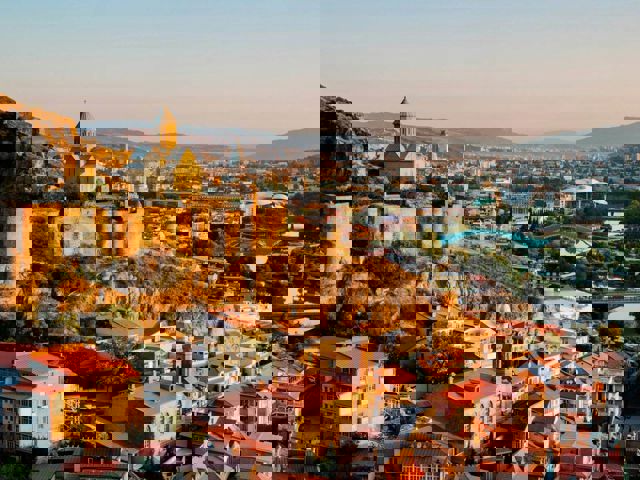
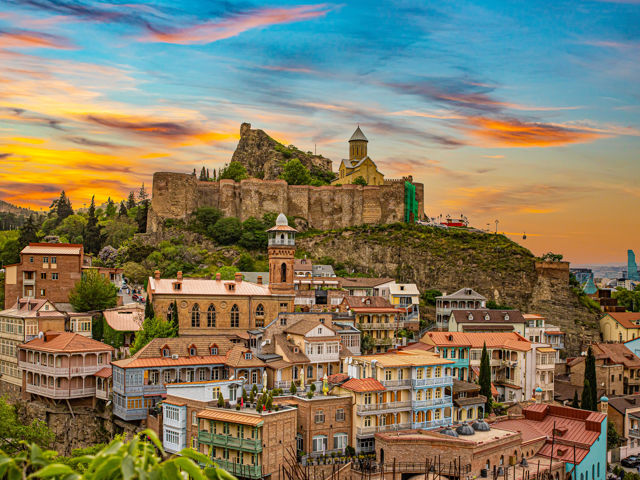
They say a king named the city by accident. Hunting these hills in the fifth century, Vakhtang Gorgasali's falcon brought down a pheasant that fell into a hot spring and was cooked where it landed. The king called the place Tbilisi — from tbili, "warm" — and moved his capital to the water. Fifteen centuries later the springs still rise beneath the brick domes of Abanotubani, and the city is still defined by its warmth.
Tbilisi sits on the old road between Europe and Asia, and everyone who travelled it left something behind. Persian and Ottoman traders, Russian governors, Armenian merchants, Soviet planners — their mosques, churches, synagogues, balconied houses, and grand avenues stand within a few minutes of one another and somehow agree to get along. Carved wooden galleries lean over courtyards; a glass bridge arcs toward an ancient fortress; a funicular climbs to a park on the mountain above it all.
What holds it together is the table. Georgians treat a guest as a gift from God, and the proof arrives as a supra — a feast of khachapuri and khinkali, herbs and walnuts, and wine made the way it has been here for eight thousand years, in clay vessels buried in the earth.
Step out of the hotel and the city begins at once. The rest, our concierge will help you find.